

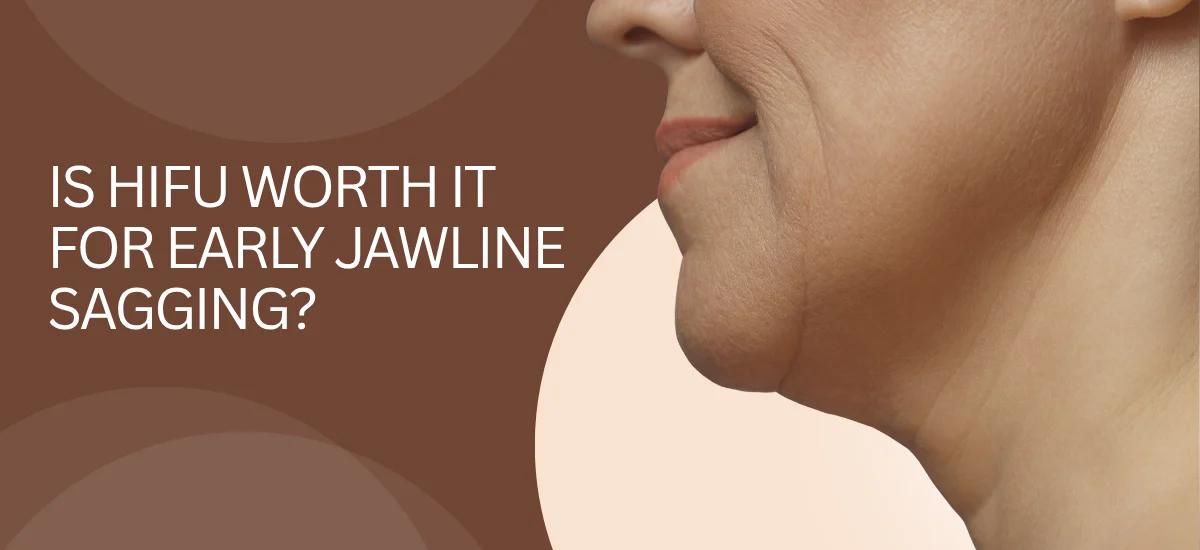
For a jawline that’s just starting to lose its shape, HIFU generally does pay off. It uses focused ultrasound to heat tissue at a set depth under the skin, and that triggers new collagen over the next several weeks. Nothing changes on the day of the procedure. Patients who know this beforehand tend to be satisfied with what they see later; the ones expecting an immediate lift usually aren’t. Once the sagging has gone past that early stage, HIFU isn’t really the right tool anymore, and a facelift or thread lift tends to come up instead.
According to Dr. Pooja Chopra, a Dermatologist in Andheri West, Mumbai at The SkinTalk Clinic, “Most people come in after the jawline has already dropped, not while it’s still holding some elasticity. That six-month gap matters more than patients realise. HIFU works with what’s still there, not what’s already gone.”
01
What Causes Early Jawline Sagging?
Jawline softening rarely comes from one thing. Two or three causes are usually stacking up quietly for years before anyone actually notices.
- Collagen and elastin decline: the skin’s support structure thins from the mid-20s onward, so firmness starts fading long before any sagging is visible.
- Fat pad shifting: cheek fat that used to sit higher gradually moves downward with age and gravity, settling near the jaw and softening its outline.
- Cumulative sun exposure: unprotected sun over the years, along with habits like smoking, breaks down collagen at a faster rate than ageing alone.
- Skeletal and muscle change: the jawbone reshapes slowly over decades, and thinning muscle underneath makes the area look looser than it once did.
Jawline softness rarely arrives alone. If other early signs of ageing are showing too, a consultation can help you explore the facial rejuvenation options.
02
How Does HIFU Treatment Work for Jawline Sagging?
The mechanism behind HIFU treatment is fairly specific, and knowing it helps explain why the results take time.
- Focused ultrasound energy reaches a precise depth under the skin, the same SMAS layer surgeons work on during a facelift, without any incision involved.
- The tightening comes from repair, not the treatment itself: small, controlled points of heat prompt the body to rebuild collagen on its own over the following weeks.
- Change shows up in stages. Something’s usually visible by week three or four, though the full effect doesn’t settle in until closer to 8 to 12 weeks.
- One session is often enough for early sagging, and most patients don’t need to think about a repeat for close to a year.
If lip pigmentation is another facial concern you’re noticing, you can read our article on lip pigmentation to learn more.
03
Why Choose Dr. Pooja Chopra?
Dr. Pooja Chopra has an MD in Dermatology and Venereology, with 19 years of practice behind her. Jawlines don’t all respond the same way, so energy and depth settings are worked out for each patient rather than applied off a fixed template. She’s also recognised as a Key Opinion Leader for Juvederm, Restylane, and Botox, and takes time out to train other dermatologists in these techniques. The clinic has been a fixture in Andheri West since 2012, and consultations here don’t end without a clear picture of what HIFU will and won’t do for that particular face.
04
FAQs
1. How many HIFU sessions are needed for jawline sagging?
One, in most early cases. If sagging runs deeper, a second round gets discussed around the 9 to 12 month mark, once it’s clear how well the first one held.
2. Is HIFU treatment painful?
Expect warmth, and occasionally a sharp little pinch right along the jawbone. Most people skip the numbing cream entirely, though it’s there for anyone who’d rather use it.
3. How soon will I see results after HIFU?
Some early tightening appears within a few weeks. The result worth actually judging, though, doesn’t fully show until around 8 to 12 weeks in.
4. Can HIFU replace a facelift for jawline sagging?
Not once sagging is moderate to severe. HIFU has its limits, and past a certain point, only a surgical facelift or thread lift can do what ultrasound energy can’t.
05
References
Disclaimer: This blog is for educational purposes only and does not replace professional medical advice.
